

Solving the Puzzle of Low Back Pain and SI Joint Dysfunction
What is Sacroiliac (SI) joint dysfunction?
The sacroiliac (SI) joint is a synovial joint connecting the sacrum at the base of the spine to the ilium of the pelvis. It plays a crucial role in transferring weight from the upper body to the lower limbs and stabilizes the pelvis during movement. The joint is reinforced by strong ligaments and allows minimal motion, primarily gliding and rotation.
SI joint pain arises when these joints become inflamed or dysfunctional due to injury, arthritis, pregnancy, or biomechanical imbalances. Symptoms can range from lower back, buttock, and leg pain that may worsen with prolonged sitting, standing, or movement. Conditions like sacroiliitis (inflammation) and SI joint dysfunction (abnormal movement) are common causes.
Prevalence estimates suggest that SI joint pain accounts for approximately 15–30% of chronic low back pain cases.1-5
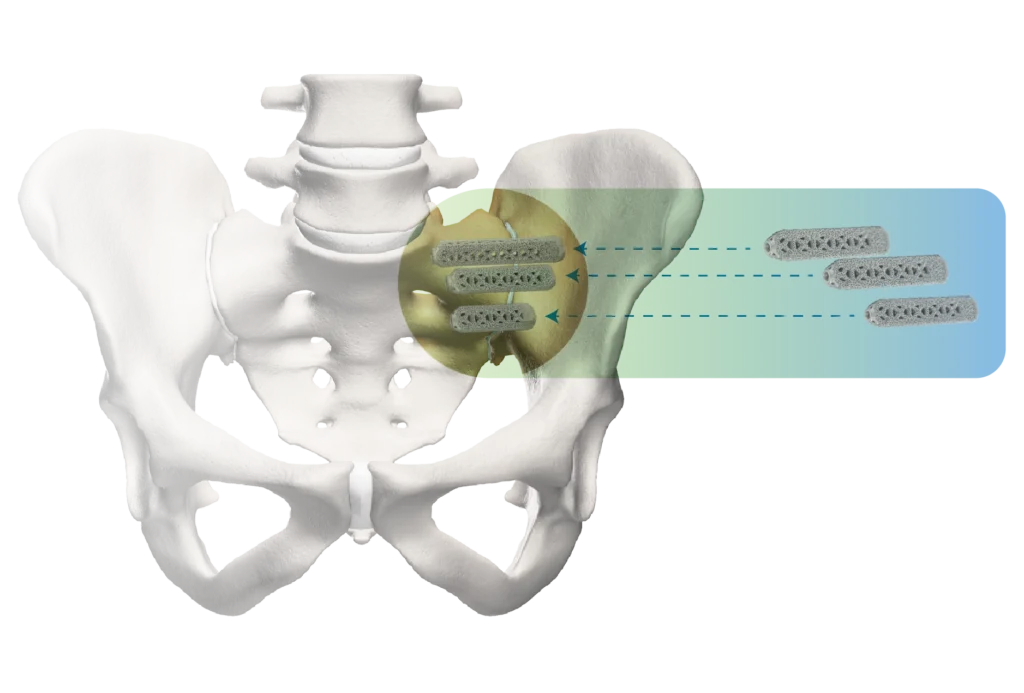
THE SI-BONE® SOLUTION: THE iFUSE 3D™ IMPLANT SYSTEM
The iFuse 3D™ Implant System offers a clinically proven, minimally invasive solution for sacroiliac (SI) joint dysfunction. Engineered with a patented triangular design, iFuse 3D provides superior rotational stability—six times greater than traditional screws—and immediate joint stabilization.6 Its 3D-printed porous surface promotes robust bone ongrowth, ingrowth, and through growth enabling durable fusion.7 Through a small incision and typically a lateral approach, 2-3 triangular titanium implants are placed across the SI joint, minimizing tissue disruption and recovery time. Backed by more than 180+ peer-reviewed publications and long-term data, iFuse 3D demonstrates high patient satisfaction (95%), significant pain reduction, and decreased opioid use.8
With its biomechanical strength, ease of implantation, and strong clinical outcomes, iFuse 3D empowers surgeons to deliver lasting relief and improved quality of life for patients suffering from SI joint disorders.
The Real World Impact for Patients
Mercedez Holmes enlisted in the Navy in 2006. Originally from Victoria, BC, he served as a combat medic with the 2nd Marine Division. On April 11th, 2007, a coordinated attack on his base left Holmes with severe and chronic back pain that made daily activities like walking, running, and even simple chores increasingly difficult. Eventually, parts of his legs grew numb.
Despite trying numerous treatments, including acupuncture, chiropractic care, and prescription medications—Mercedez found no relief. It wasn’t until an acupuncturist used electrostimulation that the source of his pain was identified: the sacroiliac (SI) joint.
Two years later, a chiropractor confirmed the SI joint diagnosis and referred Mercedez to pain management. There, he received several injections and was diagnosed with bilateral SI joint dysfunction and lumbar spine issues.
Following this diagnosis, he consulted a neurosurgeon who performed an L4-L5 TLIF procedure. While this slightly reduced his pain, the surgeon recommended SI joint fusion. Mercedez underwent his first SI joint fusion on the left side, which resulted in immediate pain relief. He later had a second fusion on the right side with similarly positive results.
Today, he enjoys daily activities once lost to pain. After years of unsuccessful treatments, the iFuse 3D procedure provided him with significant relief, and a path towards independence. Mercedez describes the iFuse 3D procedure simply and powerfully: “You’ve given me my life back.”
1. Bernard TN Jr, Kirkaldy-Willis WH. Recognizing specific characteristics of nonspecific low back pain. Clin Orthop Relat Res. 1987 Apr;(217):266-80.
2.Schwarzer AC. Te Sacroiliac Joint in Chronic Low Back Pain. Spine. 1095:20(1):31-7.
3. Maigne JY, Aivaliklis A, Pfefer F. Results of Sacroiliac Joint Double Block and Value of Sacroiliac Pain Provocation Test in 54 Patients with Low Back Pai. pine.1996;21:1889-92
4.Irwin RW, Watson T, Minick RP, Ambrosius WT. Age, Body Mass Index and Gender Differences in Sacroiliac Joint Pathology. Am J Phys Med Rehabil. 2007 Jan;86(1):37-44
5. Sembrano JN, Polly DW Jr. How Often is Low Back Pain Not Coming From the Back? Spine. 2009 Jan;34(1):E27-32.
6. SI-BONE Technical Study 300610-TS
7. MacBarb RF, Lindsey DP, Woods SA, Lalor PA, Gundanna MI, et al. Fortifying the Bone-Implant Interface Part 2: An In Vivo Evaluation of 3D-Printed and TPS-Coated Triangular Implants. Int J Spine Surg. 2017 Jun 1;11:16
8. Whang PG, Darr E, Meyer SC, Kovalask D, Frank C, et al. Long-Term Prospective and Radiographic Outcomes After Minimally Invasive Latreal Transiliac Sacroiliac Joint Fusion Using Triangular Titanium Implants. Med Devices (Auckl).2019;12:411-422